แสดงบทความที่มีป้ายกำกับ Supply Chain Management Model แสดงบทความทั้งหมด

วันจันทร์ที่ 23 เมษายน พ.ศ. 2561

Supply Chain Excellence House (ตัวแบบสู่ความเป็นเลิศในการจัดการโซ่อุปทาน)

English Version

หลายคนที่สนใจเรื่องการจัดการโซุอุปทาน หรือ Supply chain Management คงมีคำถามอยู่ในใจว่าถ้าจะพัฒนาการจัดการโซ่อุปทานอย่างเป็นระบบ มีตัวแบบยังไงบ้าง 

Blog ครั้งนี้ของผมเลยขอนำเสนออีก 1 ตัวแบบ ที่ที่ปรึกษาอย่างผมประยุกต์ขึ้นมาใช้งานเพื่อให้สอดคล้องกับบริบทของสถานประกอบการของไทย เพื่อใช้ในการพัฒนาอย่างต่อเนื่องและยั่งยืน ซึ่งตัวแบบ (Model) ดังกล่าวนี้เกิดจากการบุรณาความรู้และประสบการณ์จากให้คำปรึกษาสถานประกอบการ ซึ่งประกอบด้วยองค์ความรู้ด้าน Lean, TQM/TQA และ SCOR Model แล้วประกอบองค์ความรู้เหล่านั้นเป็นรูปบ้านเป็นตัวอธิบายความเชื่อมโยงต่างๆ ซึ่งสามารถอธิบายได้ดังภาพที่ 1

Supply Chain Excellence House, Mongkol P : naitakeab@gmail.com

จากภาพที่ 1 การพัฒนาสู่ความเป็นเลิศในการจัดการซัพพลายเชน (Supply Chain Management) มีโครงสร้างของกระบวนการพัฒนาปรับปรุงเพื่อนำไปสู่ความเป็นเลิศ  ประกอบด้วยส่วนต่างๆ คือ 

  1. ฐานราก คือ การพัฒนาทักษะความบุคลากรให้มีทักษะในการปฏิบัติงานแต่ละด้านให้สอดคล้องตามกระบวนการดำเนินงานด้านนั้นๆ โดยองค์ประกอบของการพัฒนาทักษะการปฏิบัติงานให้ความสำคัญ 3 ส่วน คือ  ความถนัด (Aptitude) ประสบการณ์ (Experience) และการฝึกอบรม (Training)
  2. พื้น คือ คือ ระบบการจัดการเทคโนโลยีสารสนเทศของโช่อุปทาน (ซัพพลายเชน) โดยเป็นการจัดการข้อมูลที่ถูกต้องเพื่อใช้ในสถานการณ์และสถานที่ที่ถูกต้อง เป็นการแลกเปลี่ยนข้อมูลสารสนเทศที่ทำให้ระบบเชื่อมโยงเข้าด้วยกัน สามารถตอบสนองต่อความต้องการของลูกค้า และกลยุทธ์ขององค์กร
  3. เสาการจัดการกระบวนการ คือ กระบวนการดำเนินงานที่ต้องพัฒนาและเพิ่มประสิทธิภาพ สร้างความเชื่อมโยงทั้ง Supply Chain ประกอบด้วย คือ กระบวนการขาย/ตลาด (Sale/Marketing) กระบวนวางแผน (Plan) กระบวนการจัดหา (Source) กระบวนการแปรรูปหรือผลิต (Make) กระบวนการส่งมอบ (Deliver) กระบวนการส่งกลับ (Return) และกระบวนพื้นฐานเพื่อเป็นกลไกขับเคลื่อนโซ่อุปทาน (Enable)
  4. เสาเครื่องมือ/หลักปฏิบัติ โดยเริ่มต้นด้วยเครื่องมืออย่างง่าย และพัฒนาขึ้นตามลำดับ ดังนี้ คือ 
    • การกำจัดความสูญเปล่าในการปฏิบัติงาน (Waste Elimination) ที่เกิดขึ้นตลอดโซ่อุปทาน
    • การนำเทคนิค เครื่องมือและหลักการปฏิบัติมาตรฐาน (Standard Practice) มาใช้ในการพัฒนากระบวนการทำงานภายในโซ่อุปทาน 
    • การนำเทคนิค เครื่องมือและหลักการปฏิบัติที่ดี (Best Practice มาใช้ในการพัฒนากระบวนการทำงานภายในโซ่อุปทาน 
    • การนำเทคนิค เครื่องมือและหลักการปฏิบัติเชิงนวัตกรรม (Innovation Practicesมาใช้ในการพัฒนากระบวนการทำงานภายในโซ่อุปทานหลักการปฏิบัติเชิงนวัตกรรม (Innovation Practices)
  5. เสาช่องทางการบริหาร (Promotion Vehicle) เป็นรูปแบบในการบริหารงานในลักษณะต่างๆ ทั้งการบริหารให้เป็นไปตามนโยบาย (Policy Management) การบริหารงานประจำวัน (Daily Management) การบริหารความเชื่อมโยง (Collaboration Management) การบริหารความเสี่ยงในซัพพลายเชน (Risk Management) รวมทั้งการส่งเสริมกิจกรรมพื้นฐาน (Bottom-up Activity) เพื่อส่งเสริมให้เกิดการพัฒนาปรับปรุงอย่างเป็นระบบและสอดคล้องตามสถานการณ์ที่เกี่ยวข้อง
  6. เสาแนวคิด/ค่านิยม (Value/Concept)  คือ ความเชื่อและพฤติกรรมที่ควรสร้างเพื่อให้ฝังลึกอยู่ในองค์กร และผู้ปฏิบัติงานภายใต้ซัพพลายเชนเดียวกัน เพื่อให้เกิดผลการดำเนินงานที่เป็นเลิศ ค่านิยมและแนวคิดหลักจะเป็นรากฐานที่ก่อให้เกิดความเชื่อมโยงระหว่างกระบวนการทำงานด้านต่างๆ ภายใต้ซัพพลายเชนเดียวกัน และผลการดำเนินการที่สำคัญ
  7. คาน คือ ตัวชี้วัดสมรรถนะในการปฏิบัติการด้านต่างๆ ภายในซัพพลายเชน โดยแบ่งการวัดผล เป็น 3 กลุ่มหลัก 7 ด้าน คือ
    • ด้านการตอบสนองความต้องการของลูกค้า (External Focus) ประกอบด้วย 3 ด้าน คือ ความน่าเชื่อถือ ความรวดเร็ว ความคล่องตัวในการปรับเปลี่ยน 
    • ด้านการตอบสนองต่อการจัดการภายในองค์กร (Internal Focus) ประกอบด้วย 3 ด้าน คือ ประสิทธิภาพการจัดการสินทรัพย์ ด้านต้นทุน และรายได้
    • ด้านการตอบสนองต่อสังคมเพื่อความยั่งยืน (Sustain Focus) โดยให้ความสำคัญต่อผู้มีส่วนได้ส่วนเสียกับสถาบัน เพื่อสร้างความยั่งยืนในการดำเนินงานให้กับสถาบัน
  8. หลังคา คือ ผลลัพธ์ขั้นสุดท้ายที่เกิดจากการพัฒนาปรับปรุง ซึ่งนำองค์กรไปสู่ความเป็นเลิศในการจัดการโซ่อุปทาน 
ลองนำไปใช้ดูนะครับ รับรองชีวิตการทำงานร่มเย็น สดใส สไตล์ไทยๆ แน่นอน

สนใจยกระดับการทำงานให้มีประสิทธิภาพ ติดต่อเราได้ที่ https://rightwayhub.com
สนใจการฝึกอบรมแบบ In-house Training แจ้งความต้องการได้ที่ https://rightwayhub.com/training

มงคล  พัชรดำรงกุล
วิทยากร/ที่ปรึกษา/ผู้เชี่ยวชาญการจัดการโลจิสติกส์และโซ่อุปทาน 
LineID : naitakeab, Tel 081-8476479 

วันอังคารที่ 13 กุมภาพันธ์ พ.ศ. 2561

Supply Chain Excellence House : The Model of Supply Chain Management

สำหรับภาษาไทย

Many people who are interested in supply chain management still have a question in mind whether to develop supply chain management systematically.

This blog will be introduce about the model of supply chain management which integrated the concept of Lean,TQM and SCOR model plus the consulting experience in Thailand.

This supply chain management model was presented via the picture of house to explain the connectivity of activities that need to focus and take action in supply chain. See the picture for detail.
Supply Chain Excellence House : Model of Supply Chain Management 


The picture above is the model of supply chain management that have the structure for develop to be excellence following 
  1. Groundwork This section are skills development of the personnel to perform each task in accordance with the operational process. The components of skill development are three areas of importance: aptitude, experience, and training.
  2. Floor This section is the "supply chain information technology" management which must right information to use in the right situation and place. Organization must establish the system to manage and monitoring information that linked whole supply chain to be meet the needs of customers and corporate strategy. The Supply Chain information technology such as 
    • Software Systems 
    • Electronic Data Interchange (EDI) 
    • Material Requirements Planning (MRP)
    • Enterprise Resource Planning (ERP)
    • Supply Chain Management Systems (SCM)
    • Customer Relationship Management (CRM)
    • Internet-based Software
    • Network Infrastructure
    • Wide Area Network,
    • Internet (for E-commerce: B2B, B2C) etc.
  3. Process-Pillar This section are the primary management processes to organized,controlled and developed to be more effective. The processes contains selling / marketing, Plan,Source, Make, Deliver and Enable.
  4. Tools/Practice Pillar This section This section start with a simple tool and developed in the following order.
    • Waste Elimination. This is the Lean concept to eliminate the wastes whole Supply Chain 
    • Standard practice, Standard practices are how a wide range of companies have historically done business by default or happenstance.These well-established practices do the job, but don’t provide a significant cost or competitive advantage over other practices. Risk: Low, Results: Low
    • Best practices, Best practices are 'current', 'structured' and 'repeatable' practices that have had a proven and positive impact on supply chain performance. Risk: Moderate, Results: Moderate. 
    • Innovation practices, Innovation practices are the new creation technology, knowledge or radically different ways of organizing processes. Risk: High, Results: High. 
  5. Driven  Management Pillar This section are the various on management to drive all activities in organization and linked whole supply chain to promote systematic and consistent development to be effective. 5 driven managements are 
    • Policy Management 
    • Daily Management
    • Collaboration Management 
    • Risk Management 
    • Bottom-Up Activity such as 5S, Kaizaen, QCC
  6. Concepts/Core Value Pillar This section are the This section are the concepts, behaviors, core value of team should be created and embedded in the organization to achieve excellent performance. Core Values and concepts are the foundation for linking work processes under the same supply chain.
  7. Beam This section are the performance indicators to measure the process activities whole supply chain.The measurement is divided into 3 main groups and 7 attributes
    • External Focus :  The performance indication for response and support  the customer are including 3 attributes ; Reliability, Rapidly, Agility  
    • Internal Focus :  The performance indication for response and support  the organization are including 3 attributes ; Revenue, Cost, Asset Management Efficiency 
    • Social Focus :  The performance indication for response and support social and excellent foundation for environmental accounting and sustainable in the supply chain  
  8. Roof This section is Final result of improvement and development. This leads the organization to excellence in supply chain management. 
How do you feel about this "The Supply chain Excellence House"  the model of Supply chain Management?  Hope it's useful for you and someone who read this blog. If your have any question or advice, don't hesitate to contact me.

Mongkol  Patcharadamrongkul
Instructor/Consultant
Expert in Productivity Improvement, Logistics and Supply Chain Management,
Thailand, Tel 081-8476479, E-mail : naitakeab@gmail.com 

13 February 2018

SCOR 12.0 : Version ใหม่ล่าสุด ของการจัดการโซ่อุปทานจาก APICS

เมื่อ 11 ตุลาคม 2560 ทาง APICS ได้ประกาศเปลี่ยนแปลง Ver. ของ SCOR เป็น SCOR 12.0 ซึ่งน่าจะเป็นการเปลี่ยนแปลง Version  ของ SCOR เป็นครั้งแรกหลังจากการ Merge กัน ของ SCC และ APICS เมื่อปี 2014 โดยภายใต้การเปลี่ยนแปลงครั้งนี้ มีหลายอย่างที่ได้พัฒนาปรับปรุง และน่าสนใจ อาทิ
  1. การเปลี่ยนรูปแบบการสร้าง Workflow เพื่อเชื่อมโยงการทำงานทั้ง Supply Chain โดยสามารถทำได้ผ่าน SCOR BPM Accelerator
  2. ปรับแแก้คำนิยามต่างๆในกระบวนการ Make, Deliver, Enable ให้เข้าใจ และเป็นนิยามที่ใช้กันทั่วไปมากขึ้น
  3. กำหนดให้ SCOR เป็นตัวแทนของการจัดการ Supply Chain และเป็น Element สำคัญใน Value Chain ของ APICS Framework
  4. Process-Hirarsky
    ที่มา : Supply Chain Operations Reference Model :SCOR Version 12.0, www.apics.org
  5. จัดทำ SCOR Process Hierarchy ให้เข้าใจได้ง่ายหน่อย ดังภาพ 
  6. ด้าน Performance มีการปรับเปลี่ยนตัววัด โดยการเปลี่ยน Total Cost To serve เป็น Total Supply Chain Cost (CO.1.1) และนำ Cost of Goods Sold (COGS) (CO.1.2) กลับมาอยู่ใน Performance Attribute Level-1 อีกครั้ง รวมทั้งปรับแก้ตัววัดหลัก Level-1 ด้าน Agility จาก 4 ตัวเหลือเพียง 3 ตัว
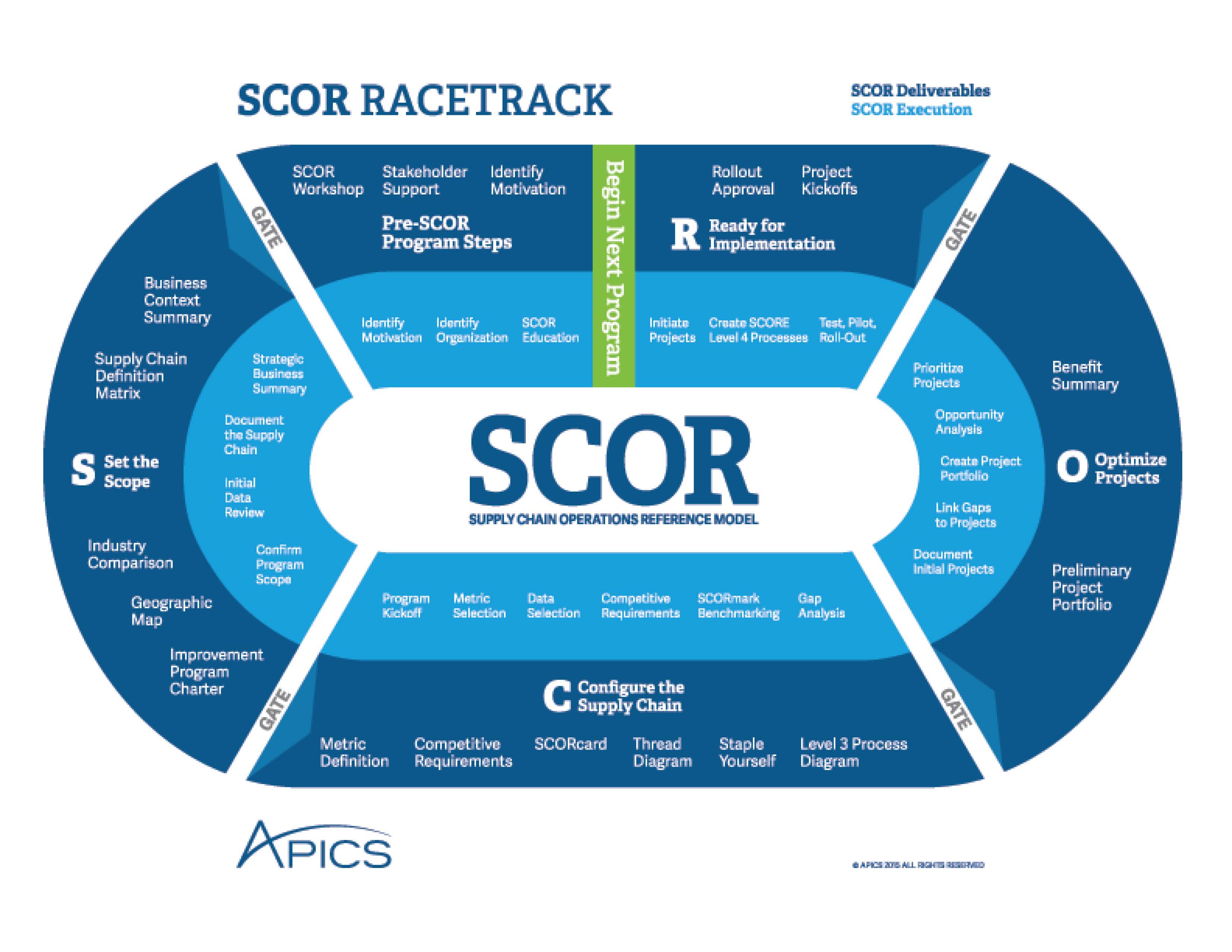
  7. scor-racetrack
    ที่มา : Supply Chain Operations Reference Model :SCOR Version 12.0, www.apics.org
  8. เพิ่ม SCOR Improvement Program and SCOR Racetrack เพื่อให้สะดวกในการนำไปเป็นแนวทางในการพัฒนาปรับปรุง
  9. มีการเพิ่ม Emerging Practice ใหม่่เข้ามาหล่ายตัว คือ
    1. BP.176 Omni-channel
    2. BP.177 Additive Manufacturing
    3. BP.178 Block Chain
    4. BP.179 Demand Driven MRP
    5. BP.180 Demand Driven S&OP
    6. BP.181 Digital Supply Chain
    7. BP.182 Internet of Things
    8. BP.183 Integrated Business Planning
    9. BP.184 Scenario Planning
    10. BP.188 SCM Object Synchronization – “3/4-way Match”
  10. มีการยกระดับหลักปฏิบัติเป็น Best Practice คือ
    1. BP.173 Supply Chain Risk Monitoring
    2. BP.174 Supply Chain Risk Assessment
    3. BP.175 Metadata
    4. BP.185 Cost of Quality
    5. BP.186 Data / Analytics
    6. BP.187 Supply Chain Finance
    7. BP.180 Demand Driven S&OP
    8. BP.181 Digital Supply Chain
    9. BP.182 Internet of Things
    10. BP.183 Integrated Business Planning
    11. BP.184 Scenario Planning
    12. BP.188 SCM Object Synchronization – “3/4-way Match”
ลองไปศึกษาเพิ่มเติมกันนะครับ ผมว่ามีหลายอย่างน่าสนใจ และทันสมัยมากขึ้น ง่ายต่อการใช้มากขึ้นด้วย และต่อจากนี้ เมื่อคุยเรื่อง SCOR ต้องบอกว่า SCOR 12.0 ไม่งั้นเชยแน่นอน 555..มีความสุขในการการพัฒนาและเปลี่ยนแปลงตามเทคโนโลยีของโลกทุกคนนะครับ

สำหรับใครที่สนใจบทความเกี่ยวกับ SCOR Model นำองค์ประกอบของ SCOR ไปประยุกต์ใช้ ผมได้ที่เขียนไว้ สามารถเข้าดูเพิ่มเติมได้ที่นี้ครับ

  1. กลั่น SCOR Model : Model เพื่อการจัดการโซ่อุปทาน ให้เรียนรู้และเข้าใจ ใน 1 Page
  2. Supply Chain Excellence House (ตัวแบบสู่ความเป็นเลิศในการจัดการโซ่อุปทาน)

มงคล  พัชรดำรงกุล
วิทยากร/ที่ปรึกษา/ผู้เชี่ยวชาญการจัดการโลจิสติกส์และโซ่อุปทาน 
LineID : naitakeab, Tel 081-8476479 

Data Literacy: ทักษะที่คนทำงานยุค AI ต้องมี (แต่ความจริงคือ...อาจไม่มีใครรู้จริง)

ในวันที่กระแส AI (Artificial Intelligence) พัดถล่มทุกวงการ ผมได้เห็นปรากฏการณ์ที่น่าสนใจและน่ากังวลไปพร้อมกัน ทั้งในมุมมองของคนรุ่นใหม่ที่ก...