คือ การบูรณาการของการวางแผนการทำงานระหว่าง E2E ในแบบ End to End และ Enterprise to Enterprise รวมทั้งสร้างการทำงานแบบ Real Time เพื่อขับเคลื่อนการดำเนินที่มีประสิทธิภาพของการจัดการตลอดโซ่อุปทาน แน่นอนครับการวางแผน (Plan) คือกระบวนหลักในการจัดการ Supply Chain และเป็นต้นกำเนิดของดำเนินงานด้านอื่นๆ (คลิกดูกระบวนหลักของการจัดการ Supply Chain) ดังนั้นเราต้องพัฒนาระบบการวางแผนของเรา หรือยกระดับ ERP ของเราให้สามารถรวบรวมและเชื่อมโยงข้อมูลผ่านการทำงานร่วมกับลูกค้า หรือ Supplier แบบ Real Time
สำหรับภาษาไทย Every day, every working people must be think, to be action, to solve issue, to manage team, to make decision under differentiate working situation, more or less upon the responsibility. Normally, the management vehicle that use to drive to be meet the cooperate objectives consists of 5 driven management are;
Policy Management
Daily Management
Collaboration Management
Risk Management
Bottom-Up Activity such as 5S, Kaizaen, QCC
The 5 driven management methods are the 1 of 4 pillars under "Supply Chain Excellence House", please click link for more details.
For this blog, I would like to introduce the driven management method that closely the routine work. That's "Daily Management (DM) Technique". What is the daily management? Daily management is "all activities that are routinely performed to effectively achieve the responsibilities of each working task/working area. Basically, this is an activity for keeping the exsiting condition, but also still need to continuous improvement.
Daily Management (DM) is related to Policy management (PM). The policy management focuses on the improvement via the PDCA cycle. Daily Management is focused on keeping the existing condition and improving the work by rotating the SDCA cycle. And also, If found the crisis situation during daily Management performance,the policy management is revised. See the picture for more details.
Daily Management mechanism and relation of DM and PM
So let's to see, how to do for Daily management?. It's able separate to 7 steps as below.
Understand your work.
This step >> Tell your work yourself, the purpose of the work, the goal that you want from the job, I recommend covering 5 goals from your existing jobs.
Determine the works standard / control point / checkpoint
This step will be define the standard of work, control point, check point to know the abnormal process/result. Control point is the result indicator and check point is the Process indicator
Practical leaning and training for yourself and your team to follow standards.
After define work standard, next process are make the practitioner understand what to do. Learning and training in practice with good practice skills.
Encourage and motivate the practitioner work compliance with standards
Process oriented is the must to do. This step is to take action. Leaders have the duty to make the team to work follow their believe in what needs to be done more than forced to do only.
Follow up / Monitor / Control
This step need someone to take response and also establish the system to follow up, monitoring and control. The system such as Visual Management,Control Graph etc.
Supervisor Level: At least hourly or less to follow up and monitor the process and result.
Manager Level : Half a day, daily, weekly to follow up and monitor the process and result.
Fast action when abnormal
Under the monitoring and control system, wheh found the abnormal of result or process. It is necessary to take immediate action. The concept of 2-2-2 may be applied.
Problem solved yourself : Must be solved by 2 hours.
Problem solved by organization.Must be solved by 2 days.
Problem solved by outsiders or outsources: Must be solved 2 weeks
Continuous Improvement
After the problem was solved, need to review and update the work standard or control points/check point to prevent repeated problems.
Sample : Abnormal Report
The process of improvement for daily management will be explain via the process flowchart as below. This improvement flowchart look like Plan-DO-Check-Act cycle but can be applied by changing from PDCA to CAP-D instead.
Daily Management” improvement Flowchart : CAP-D
How do you feel about the technique of Daily management? Is able to make your routine job to be effective? Hope it's useful for you and someone who read this blog. If your have any question or advice, don't hesitate to contact me.
Mongkol Patcharadamrongkul Instructor/Consultant Expert in Productivity improvement, Logistics and Supply Chain Management, Thailand, Tel 081-8476479, E-mail : naitakeab@gmail.com
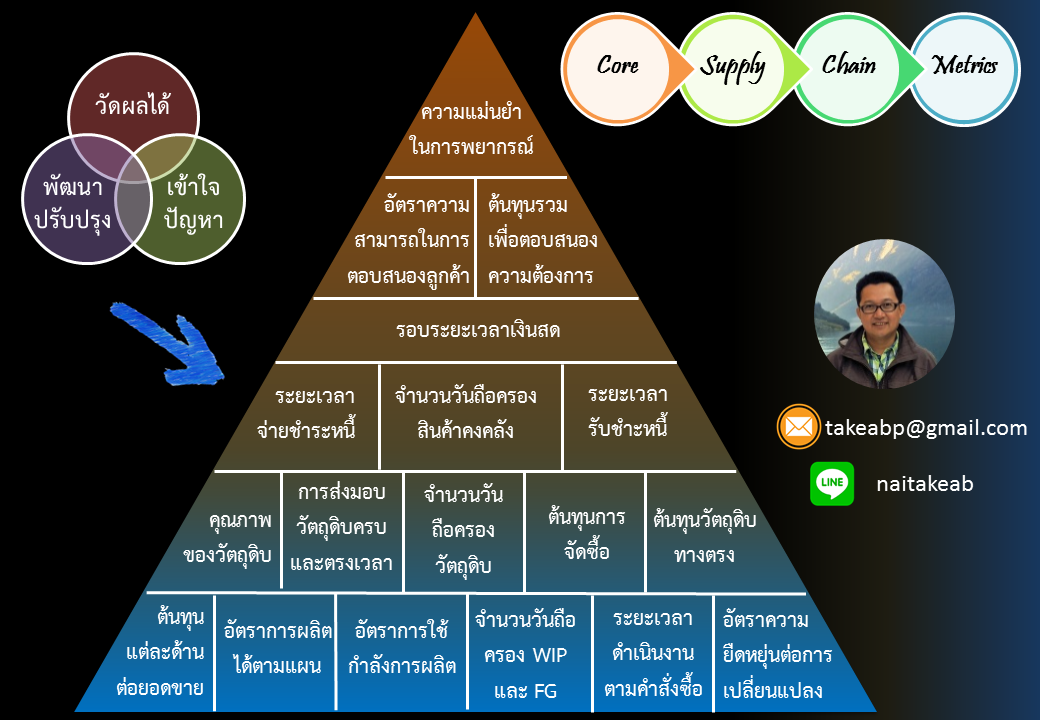
8. คุณภาพของวัตถุดิบ (Raw material Quality) คือ ความน่าเชื่อถือของวัตถุดิบที่จัดซื้อจัดหา จะต้องดีทั้งตอนตรวจรับ และการนำไปใช้งาน
9. การส่งมอบวัตถุดิบตรงเวลาและครบถ้วน ( Raw material in full and on time) คือ ประสิทธิภาพการทำงานของ supplier ที่นอกจากส่งของดีมาให้ใช้แล้ว ของดีเหล่านั้นต้องมาตรงเวลา และครบถ้วนตามเวลาที่กำหนดกันไว้
17.ระยะเวลาในการดำเนินงานตามคำสังซื้อ (Order Cycle Time) คือ ระยะเวลารวมที่ใช้ในการดำเนินงานเพื่อส่งมอบความต้องการไปยังลูกค้า หรือ Lead time ของการทำงานนั้นเอง โดยปกติจะแบ่งเป็น 3 ส่วนหลักคือ Lead time ในการผลิต, Lead Time ในการส่งมอบ และ Lead Time ในการจัดหาวัตถุดิบ แต่ถ้าหากใครสามารภแบ้งได้ย่อยกว่านี้ก็จะดียิ่งขึ้นครับ
Many people who are interested in supply chain management still have a question in mind whether to develop supply chain management systematically.
This blog will be introduce about the model of supply chain management which integrated the concept of Lean,TQM and SCOR model plus the consulting experience in Thailand.
This supply chain management model was presented via the picture of house to explain the connectivity of activities that need to focus and take action in supply chain. See the picture for detail.
Supply Chain Excellence House : Model of Supply Chain Management
The picture above is the model of supply chain management that have the structure for develop to be excellence following
GroundworkThis section are skills development of the personnel to perform each task in accordance with the operational process. The components of skill development are three areas of importance: aptitude, experience, and training.
FloorThis section is the "supply chain information technology" management which must right information to use in the right situation and place. Organization must establish the system to manage and monitoring information that linked whole supply chain to be meet the needs of customers and corporate strategy. The Supply Chain information technology such as
Software Systems
Electronic Data Interchange (EDI)
Material Requirements Planning (MRP)
Enterprise Resource Planning (ERP)
Supply Chain Management Systems (SCM)
Customer Relationship Management (CRM)
Internet-based Software
Network Infrastructure
Wide Area Network,
Internet (for E-commerce: B2B, B2C) etc.
Process-PillarThis section are the primary management processes to organized,controlled and developed to be more effective. The processes contains selling / marketing, Plan,Source, Make, Deliver and Enable.
Tools/Practice Pillar This section This section start with a simple tool and developed in the following order.
Waste Elimination. This is the Lean concept to eliminate the wastes whole Supply Chain
Standard practice, Standard practices are how a wide range of companies have historically done business by default or happenstance.These well-established practices do the job, but don’t provide a significant cost or competitive advantage over other practices. Risk: Low, Results: Low
Best practices, Best practices are 'current', 'structured' and 'repeatable' practices that have had a proven and positive impact on supply chain performance. Risk: Moderate, Results: Moderate.
Innovation practices, Innovation practices are the new creation technology, knowledge or radically different ways of organizing processes. Risk: High, Results: High.
Driven Management PillarThis section are the various on management to drive all activities in organization and linked whole supply chain to promote systematic and consistent development to be effective. 5 driven managements are
Policy Management
Daily Management
Collaboration Management
Risk Management
Bottom-Up Activity such as 5S, Kaizaen, QCC
Concepts/Core Value Pillar This section are the This section are the concepts, behaviors, core value of team should be created and embedded in the organization to achieve excellent performance. Core Values and concepts are the foundation for linking work processes under the same supply chain.
BeamThis section are the performance indicators to measure the process activities whole supply chain.The measurement is divided into 3 main groups and 7 attributes
External Focus : The performance indication for response and support the customer are including 3 attributes ; Reliability, Rapidly, Agility
Internal Focus : The performance indication for response and support the organization are including 3 attributes ; Revenue, Cost, Asset Management Efficiency
Social Focus : The performance indication for response and support social and excellent foundation for environmental accounting and sustainable in the supply chain
Roof This section is Final result of improvement and development. This leads the organization to excellence in supply chain management.
How do you feel about this "The Supply chain Excellence House" the model of Supply chain Management? Hope it's useful for you and someone who read this blog. If your have any question or advice, don't hesitate to contact me.
Mongkol Patcharadamrongkul
Instructor/Consultant
Expert in Productivity Improvement, Logistics and Supply Chain Management,
Thailand, Tel 081-8476479, E-mail : naitakeab@gmail.com
Most of executives and staffs who have the activities in the supply chain and logistics management have to involved in inventory management.
In management term, inventories are the asset that need to manage closely and effectively due to we spend more money to invest in the acquisition and hope to create value added for us. If we unfocused, the result are :
Inventories over demand -If we purchase/make to stock, the inventories costs will high and have risk to be outdated, expired, stolen, or lost,the money invested in inventories can not be exploited in other expense.
Inventories less than demand- If we kept too little inventories, risk to stock out or shortage. We will lose the opportunity to sell our products and got the money from customers. Moreover, our customer/our market may be replace by the competitors and finally we lost customer.
The necessary to kept inventory because we have to support the uncertainties case such as
Market change
Urgently required from customer
Irregular / Error from Production
Abnormal or wear of Machine
Uncertainty of Supplier
The 5 uncertainties are difficult to control but we able to manage the inventories to be efficiency. How to do? These are the conceptual framework and the relation of each activities about inventory management, see the picture for more details.
Inventory Management Efficiency Framework
From the picture above, the way to manage inventory effectively should do the following.
Classification to use/not use. The process of classification the existing inventories are still use or not use. This process like the step 1st S (S-Sort) of 5S concept.
Re-Classification for use items. Once we know what inventories are still use.The next process is re-classify the group of inventories. Normally the inventory classification techniques is "ABC Classification" but the actually we able classify by other segmentation such as VED (Vital-Essential-Desirable) or SED (Scarce-Difficult-Easy). See more details at "Because Inventory Classification is not only ABC"
Demand Forecast for each item After re-classify inventories, the next process is demand forecasting. The forecasting accuracy is the important criteria to be consider. Each organization, each time, it is not necessary to use the same forecasting technique. Select the right fit for the your organization.
Calculate Order Quantity / ROP/ SS. This process are the calculation of order quantity, Safety Stock (SS), ROP (Reorder point) . The technique is often use to calculate are EOQ, MRP, Fixed interval etc. And every time of your calculation, please consider the service level. The result will be efficiency.
Define Parameters in ERP System The current purchasing system usually works through ERP, so need to be check are update the parameters correctly.
Source/Purchase Execution When everything is set, carry out the procurement according to the conditions that we set up. The next process is purchase execution. This process able to use people or e-procurement. depending on the business process of the organization. It should control the operation of the supplier to meet the conditions.
Monitoring/Control/Continuous Improvement In general, according to the principle of supply chain, key measurement requires that 5 aspects are Reliability, Fast response, Agility, Cost, and Asset management efficiency See more details about key metric of supply chain performance at the Blog "Performance Pyramid : The key metric to manage and control whole Supply Chain" The results of monitoring and control are the guidances for the continoues improvement. Many tools and practices able to used for the improvement. Finally, go back to review the inventory is always appropriate.
How do you feel about the conceptual and framework of this inventory management? Is able to make your process to be effective? Hope it's useful for you and someone who read this blog. If your have any question or advice, don't hesitate to contact me.
Mongkol Patcharadamrongkul
Instructor/Consultant/Expert in Logistics and Supply Chain Management, Thailand